



Few sources of tattoo symbolism are as ancient and mysterious as those of the tarot. From individual cards of the major or even minor arcana to a full spread of multiple cards, there seems to be no end to what the tarot has to say. They have found a natural place in tattoo symbolism, in somewhat the same way that astrological symbols also have: by allowing tattoo wearers to reveal something about themselves through their symbol
Invented in Italy in the 1430s, the original tarot was created by adding new cards – that would eventually become the major arcana – to an existing deck with four suits. It was an era when experimentation with cards was not unusual but it would be centuries before tarot cards were used for fortune telling.
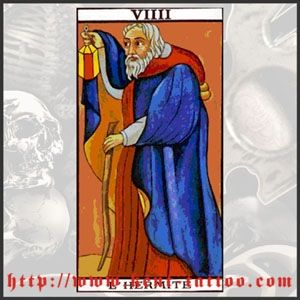
In our tattoo symbol example this month, we'll look more closely at one of the major arcana cards in particular, No. 9, The Hermit.
In France, in about 1780, tarot cards began to be used in the way that we know today, with each tarot card given its own meaning. In general, the 22 cards of the major arcana relate to larger issues in a person's life, including the spiritual, while the four suits of the minor arcana deal with the more mundane, but no less important, issues: wands for business, cups for love, swords for conflict, and pentacles for money.
The cards at right are the classic divinatory associations for the major arcana, as given in the Rider Waite Smith version of the deck. When a card is "reversed" or dealt upside-down on the table, i.e., face up, with the card showing, but with the head up and the choices.
Even as a single color tattoo, the distinct symbolism of the tarot is immediately recognizable. However, only the wearer of the tattoo knows whether to take its meaning as the philosopher-pilgrim who takes his own path in search of wisdom, or perhaps the Rider Waite Smith divinatory defintion of prudence, or even an interpretation of roguery.